
The hidden cost of using the wrong system and what purpose-built looks like for biotech and life sciences labs.
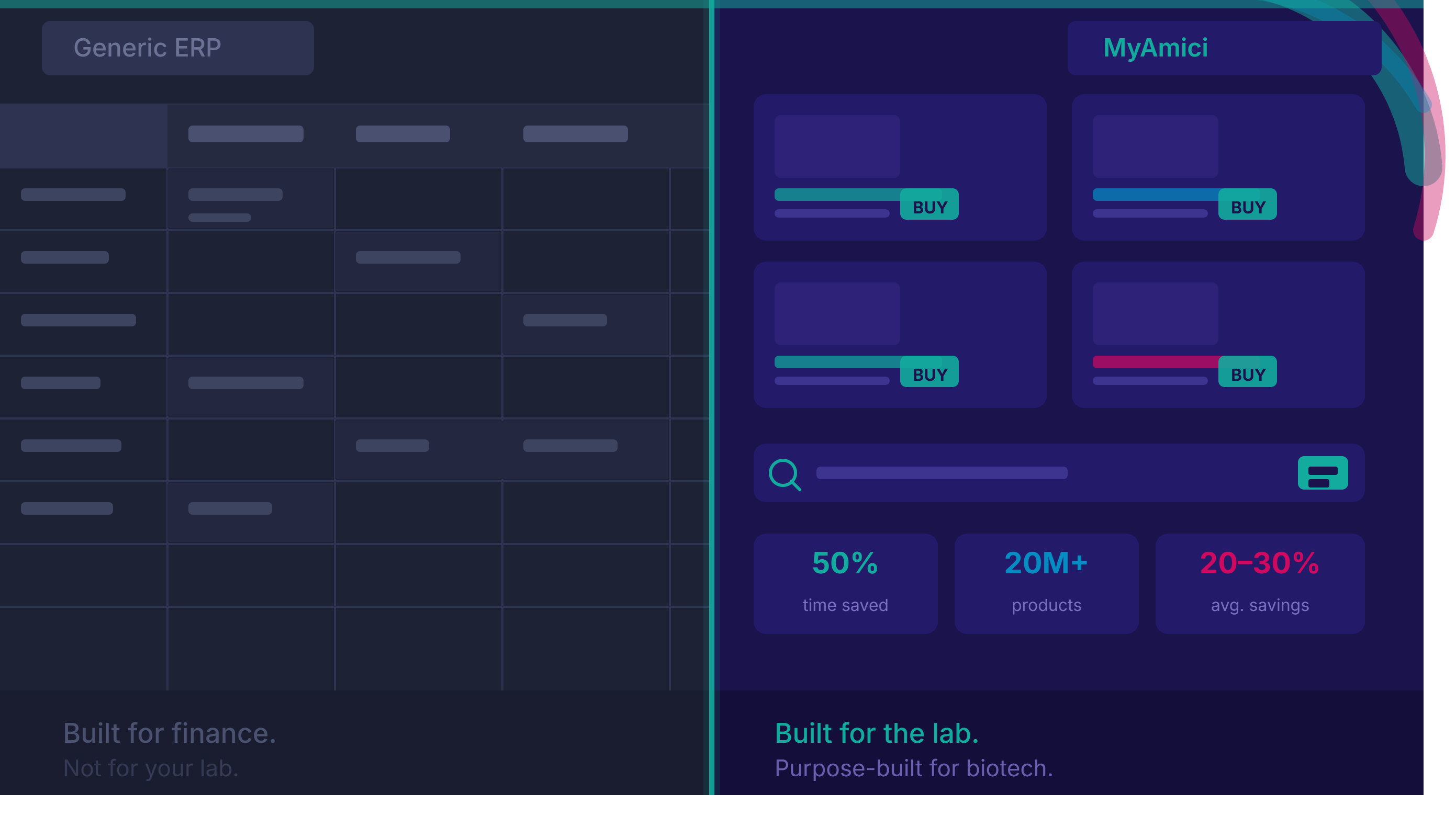
A scientist needs a reagent. They research the product across multiple supplier websites, manually note the lead time, check for hazard information, estimate whether it’s within budget, and eventually raise an order through the ERP. The procurement team reviews it does it have the right supplier pricing? Is it under the right cost centre? — and forwards it to finance. Finance checks the budget codes and approves it. The order gets placed. Then nothing.
Nobody’s officially responsible for checking whether the supplier received the PO. Nobody’s tracking the delivery. When the order arrives, someone should book it into the ERP but scientists don’t check the ERP that often, so finance ends up chasing them. The scientist checks with the goods-in team. The goods-in team might not know either. The invoice arrives before the receipt is logged. Finance is stuck.
This is the gap that ERPs were never designed to fill. And it’s costing labs more than they realise.
There’s nothing wrong with SAP, Oracle NetSuite, or Microsoft Dynamics. They’re doing exactly what they were designed to do: managing corporate spend, financial records, and reporting at scale. The problem isn’t the ERP. It’s a failure to recognise that R&D procurement has very unique requirements a generic P2P platform cannot fulfil.
A lab buys thousands of small items across hundreds of suppliers, in fact, 70% of items ordered for an R&D lab are one-off purchases. Lead times matter acutely; R&D moves at pace. Pricing is complex, with negotiated rates, framework agreements, and catalogue-level discounts that change constantly. It takes a system to manage all the quotes. Hazard compliance has to happen before the order is placed, not after. And the people placing orders are scientists, not procurement professionals.
ERPs handle none of this natively. The gap gets plugged with spreadsheets, email threads, manual supplier calls, and a lot of people doing work that shouldn’t be their job. The drag is invisible until you measure it and when labs do, the numbers are stark.
ImmuONE, a biotech company based in Stevenage, recognised this directly. Scientists were wasting time placing and chasing orders for lab consumables, pricing wasn’t always competitive, and there was no traceability or accountability in the purchasing process. As Jon Green, COO, put it: “We weren’t always getting the best prices, and our scientists were having to waste time placing and chasing orders for lab consumables. We now have traceability, accountability, and save an enormous amount of time in our purchasing processes. We’ve ticked all the boxes we set out to fix.”
MyAmici sits between the lab and the ERP, handling everything from initial sourcing through to delivery and receipt then passing clean, structured data upstream.
What that looks like in practice:
Finance gets clean PO data and receipt data in the format the ERP expects. Scientists don’t have to touch the ERP at all. Nobody rekeys anything.
It’s one of the most common concerns we hear and it’s the right question to ask.
The short answer: MyAmici owns the lab procurement workflow. The ERP owns the financial record of truth. They’re doing different jobs. We’re not trying to be a general ledger. We’re not replacing your chart of accounts. We take the messy, high-volume, lab-specific purchasing process and manage it end-to-end, then pass the clean output to your finance system in exactly the format it expects.
The longer answer: we’ve thought carefully about where the integration should sit. We work with teams early in the process to understand how their ERP has been configured often years of custom development and we design the integration around that. Sometimes the data flows from MyAmici to the ERP. Sometimes it goes the other way first. The direction depends on the workflow, not on a template.
What’s distinctive about our approach is that unlike traditional ERP implementations which typically rely on third-party consultants who can advise but can’t touch the system our integration team are the people who built the platform. Jamie Wilson, Senior Manager of Supply Chain at Ascend Advanced Therapies, put it clearly: “In previous implementations, we had to rely on third-party consultants who, while knowledgeable, had no influence on the actual system and could only tell us what was possible. With MyAmici, having support from the people who built the platform made all the difference and ensured we got the most out of the tool from day one.”
The question of whether an integration is worth the effort usually comes down to a simple calculation: what does the current process actually cost, in time and money?
Sapphiros UK, a fast-growing life sciences company combining R&D, production manufacturing, and engineering under one roof, ran their entire purchasing operation on a shared Excel spreadsheet before MyAmici, multiple people editing the same file simultaneously, scientists manually searching supplier websites and typing product codes, errors compounding with every new order. As the business scaled toward validation and clinical build, that approach was no longer sustainable.
Sam Hicks, Operations Manager and a MyAmici user across three separate companies, reviewed the numbers after a full year on the platform. The results were stark: £204,000 in average annual savings on purchasing, 34 days of time saved in order management, and a further 55 days saved through MyAmici’s sourcing function for complex or non-standard requests. Eighty-nine working days in total close to a full-time employee’s annual workload.
“Particularly for an R&D company, you very rarely get to celebrate saving money,” Sam noted. “So to be able to present average savings of £17,000 a month is just incredible.”
The inventory integration mattered as much as the purchasing connection. As Sapphiros moved through verification, validation, and into clinical build, the link between inventory and purchasing became critical. When stock runs low, the system flags it and allows the team to reorder with a few clicks. With a traditional ERP, that visibility simply doesn’t exist at the lab level.
Not all customers are replacing spreadsheets. Some come to MyAmici having already invested in an enterprise procurement platform and needing it to work properly for their lab teams.
One recent deployment illustrates the challenge. The customer had invested significantly in Coupa for their broader corporate spend. They wanted Coupa to remain the system of record. But they couldn’t find a scientific marketplace that would integrate cleanly with it and managing supplier catalogues, pricing, and data directly in Coupa was time-consuming and creating friction for the lab teams.
We built a cXML-based integration covering the full PO flow. Users log into Coupa and punch out to MyAmici accessing our catalogue and negotiated pricing. They build a basket in MyAmici, which returns to Coupa. Order confirmations and goods receipts sync back automatically. The lab teams get a purpose-built purchasing experience. Coupa stays in control on the finance and compliance side. No duplication. No parallel process.
For customers operating in GMP environments, the integration question goes beyond convenience. It’s a compliance matter.
Ascend Advanced Therapies is a Florida-based CDMO specialising in gene therapy development. Moving into GMP manufacturing meant the team needed inventory that was not just connected to purchasing but fully audit-ready with real-time batch traceability, electronic signatures, and documentation that could stand up to FDA and MHRA inspection.
Their implementation of MyAmici’s GMP inventory solution replaced a manual, Excel-based process and delivered what an ERP integration alone couldn’t: a single workflow where every inbound material, movement, test, and approval is captured in a secure audit trail. The integration between purchasing and inventory wasn’t a bolt-on it was designed into the platform from the start.
The result was a system that could grow with the business. As Ascend takes on additional clients and scales its CDMO operations, the platform provides the compliance framework and scalability required without the overhead of a traditional validated system deployment.
One of the practical advantages of having completed integrations with the same systems many times over is that customers don’t get locked into whatever was appropriate when they were a fifty-person team.
A company starting out might connect MyAmici to Xero simple, fast, and exactly what’s needed. As they grow, they move to NetSuite or SAP. MyAmici already has those integrations. The transition is a scope conversation, not a rebuild. Labs grow with MyAmici rather than having to renegotiate their entire tech stack as they scale.
Sapphiros UK illustrates this well. The platform was live within weeks of sign-off, with staff trained and the old spreadsheet retired almost immediately. “Incredibly quick, incredibly easy we were up and running in no time,” Sam recalled. That speed was possible because the implementation team had done it many times before. There was no learning curve on our side, only on theirs — and MyAmici’s interface is designed to feel like online shopping, not enterprise software.
Most labs approach the idea of an integration with understandable caution. Their experience of integration work typically connected to ERP implementations is that it’s expensive, slow, and demands a lot from internal IT teams.
Our experience is different. We complete roughly one NetSuite integration per month. We’ve done north of thirty. We know where the blockers hide, what questions to ask upfront, and how to configure the integration so it works for every team scientists, procurement, finance, and IT not just the one asking for it.
We manage the scoping, configuration, data mapping, testing, and project management. We bring the integration expertise so you don’t have to. And because we’ve done it so many times, the cost is far more accessible than customers typically expect.
Sapphiros UK is on its third implementation with MyAmici across three separate companies. Ascend Advanced Therapies has a GMP system that’s audit-ready and scaling. The businesses are different. The outcome is the same: a system that works for the lab, for finance, and for compliance without the overhead that traditional ERP integrations demand.
If you’re running an ERP and wondering whether there’s a better way to run your lab purchasing alongside it, there is.
Why don’t ERPs work well for lab purchasing?
ERPs are designed to manage corporate financial processes, general ledgers, budget reporting, accounts payable. They can manage repeatable or planned purchasing, but that isn’t the function of R&D procurement. They weren’t built for the specific, high-volume, fast-moving purchasing patterns of a research or manufacturing lab. A scientist buying reagents needs to see options, live stock availability, lead times, hazard information, and negotiated pricing at the point of ordering none of which an ERP surfaces natively. Labs also buy from hundreds of specialised scientific suppliers with complex catalogues, something a standard ERP procurement module handles poorly. The result is that scientists end up working around the ERP rather than through it, using spreadsheets, direct supplier websites, and email chains to fill the gap.
What is the difference between lab procurement software and an ERP?
An ERP manages the financial and operational record across a whole business, purchasing, accounting, HR, inventory, and reporting. Lab procurement software focuses specifically on the purchasing workflow within a scientific environment: searching scientific supplier catalogues, surfacing live lead times and pricing, routing orders through the right approvals, tracking deliveries, and managing receipts. The two are not alternatives they serve different layers of the same process. Lab procurement software handles the complexity at the lab end; the ERP handles the financial record at the corporate end. In a well-integrated setup, they talk to each other so data doesn’t have to be entered twice.
How much time do scientists typically spend on procurement admin?
More than most labs realise. Research by operations teams at life sciences companies consistently finds that scientists spend several hours per week on purchasing-related tasks searching for products, checking lead times, raising purchase requests, chasing deliveries, and booking in received orders. Estimates from Operational Teams looking at all the invisible drag and small time sinks to the know activity estimate as much as 20% of time is consumed on purchasing. The problem compounds as organisations grow: more scientists, more orders, more suppliers, and no proportional increase in procurement support.
What does a typical lab purchasing process look like without dedicated software?
In most labs without a dedicated purchasing platform, the process runs roughly like this: a scientist identifies what they need and searches supplier websites to find the right product code and lead time. They log this in a spreadsheet or email a purchasing contact. Someone collates the information andcreates order requests. The request goes through one or more approval steps often by email before a purchase order is raised manually. The PO is sent to the supplier by email or through the ERP. No one systematically tracks whether the order was received by the supplier or when it will arrive. When goods come in, someone needs to book the receipt into the ERP a step that often gets delayed, causing invoice matching problems for finance. The whole process involves five to eight manual handoffs and no single source of truth.
What are the biggest procurement challenges for fast-growing biotech companies?
Scale, pace and control tend to pull in opposite directions as biotech companies grow. Early on, purchasing is informal and flexible. As headcount grows, spend increases rapidly, but the processes don’t always keep pace. Common challenges include: no visibility of what’s been ordered or spent in real time; scientists buying direct from suppliers without going through any approval process; pricing inconsistency because discounts aren’t being applied; difficulty reconciling invoices because receipt data is incomplete; and compliance risk in regulated environments where traceability of materials is required. Moving from start-up to mid-market typically exposes all of these at once.
How do biotech companies manage purchasing between labs on multiple sites?
Multi-site purchasing is one of the harder operational problems in life sciences. Each site tends to develop its own supplier relationships, pricing arrangements, and informal processes. Without a centralised purchasing platform, there’s no spend visibility across sites, no ability to leverage combined buying power, and no consistent approval process. Finance typically sees consolidated spend only after the fact, through invoice reconciliation rather than real-time reporting. The most effective approach is a shared purchasing platform with site-level user management and cost centre assignment, integrated with a central finance or ERP system so consolidated data flows automatically rather than being aggregated manually.
Does MyAmici replace our ERP?
No and that’s intentional. Your ERP owns the financial record of truth: the general ledger, chart of accounts, and reporting. MyAmici owns the lab procurement workflow sourcing, ordering, approvals, supplier management, delivery tracking, goods receipt and can own invoice matching. Once the lab-side process is complete, MyAmici passes clean, structured data to your ERP in the format it expects. Finance gets what it needs. Nobody rekeys anything.
What ERP and systems does MyAmici integrate with?
SAP, Oracle NetSuite, Microsoft Dynamics 365, IFS, Xero, Sage, QuickBooks, Coupa, and MES/GMP systems including PASX. We’ve completed over 30 NetSuite integrations alone. If you’re running something bespoke or less common, our team will build the bridge.
How long does integration take?
Two to eight weeks for most ERP and finance integrations. Our team manages scoping, configuration, data mapping, testing, and project management. You’ll need to be available for key decisions and to share configuration details, the heavy lifting is ours.
Who does the integration work?
Mostly us. Unlike a typical ERP integration which places significant demand on your IT team and often involves third-party consultants, our in-house integration team handles setup, mapping, and testing. Critically, they’re the people who built the platform, so they can make real-time adjustments and incorporate direct feedback during implementation.
Will this disrupt how our ERP or finance team works?
No. Finance continues to work in the ERP exactly as before. What changes is that the data flowing in arrives cleaner and faster without scientists manually logging receipts or finance chasing the lab. We design integrations around your existing configuration, not over it.
Can MyAmici integrate with GMP or manufacturing systems?
Yes. MyAmici integrates with MES and GMP systems. Our GMP Inventory module is 21 CFR Part 11 compliant, FDA and MHRA audited, and includes full validation packs for computer system validation.
Does MyAmici create a parallel purchasing process?
No. There is one flow: lab teams use MyAmici, and clean PO, receipt, and spend data feeds directly into your ERP or finance system. Coupa customers access MyAmici via punch-out from within Coupa, with everything flowing back to Coupa as the system of record. No duplication. No separate process for finance to manage.
How do I choose the right R&D procurement layer to get the best of both worlds?
Start by separating the two jobs. Your ERP stays the financial record of truth; what you’re choosing is the procurement layer that sits in front of it and gives your scientists a single marketplace built around your specific business needs. Coverage is the first test: does the platform host all the suppliers and catalogues you rely on today, and the ones you’ll need as you grow? A system that leans on punch-out and hybrid catalogues rather than fully hosted ones pushes work back onto the scientist and rarely delivers a best-in-class experience, so ask who decides which catalogues are hosted, whether the provider caps that number or charges extra for it, and how it keeps product information accurate when listings change frequently. Pricing deserves the same scrutiny: how are prices managed and maintained, who owns that process, and how are price changes handled so that negotiated savings are actually delivered and increases don’t creep in unnoticed? Loose price data is also the most common source of invoice queries further down the line. It is worth understanding how quotes are managed, whether savings are guaranteed and how they are calculated, and whether the platform shows the total cost of purchase rather than unit price alone.
On the operational side, look at the depth of live stock coverage, how orders are placed and whether they can be consolidated to reduce shipping, handling, admin and environmental impact, and whether the system surfaces estimated delivery dates, dispatch notifications and delivery notices — and what happens when an order arrives late. Check that adding a new item or supplier is quick, and that you know who does it and how fast. Finally, look beneath the surface at the integration itself: who manages it and the field mapping, where your data sits, and what security accreditations the provider holds to protect information both in transit and at rest. The right answers point to a layer your scientists will genuinely use and a finance record you can trust — the best of both worlds. The quickest way to know whether a platform measures up is to talk to us.
MyAmici is a biotech procurement-as-a-service platform trusted by over 250 life sciences companies. We integrate with SAP, Oracle NetSuite, Microsoft Dynamics, Xero, Sage, Coupa, and more. Read the full Sapphiros UK case study and Ascend Advanced Therapies case study