
London Lab Live 2026 Recap: FAIR Data, AI & The Missing Middle
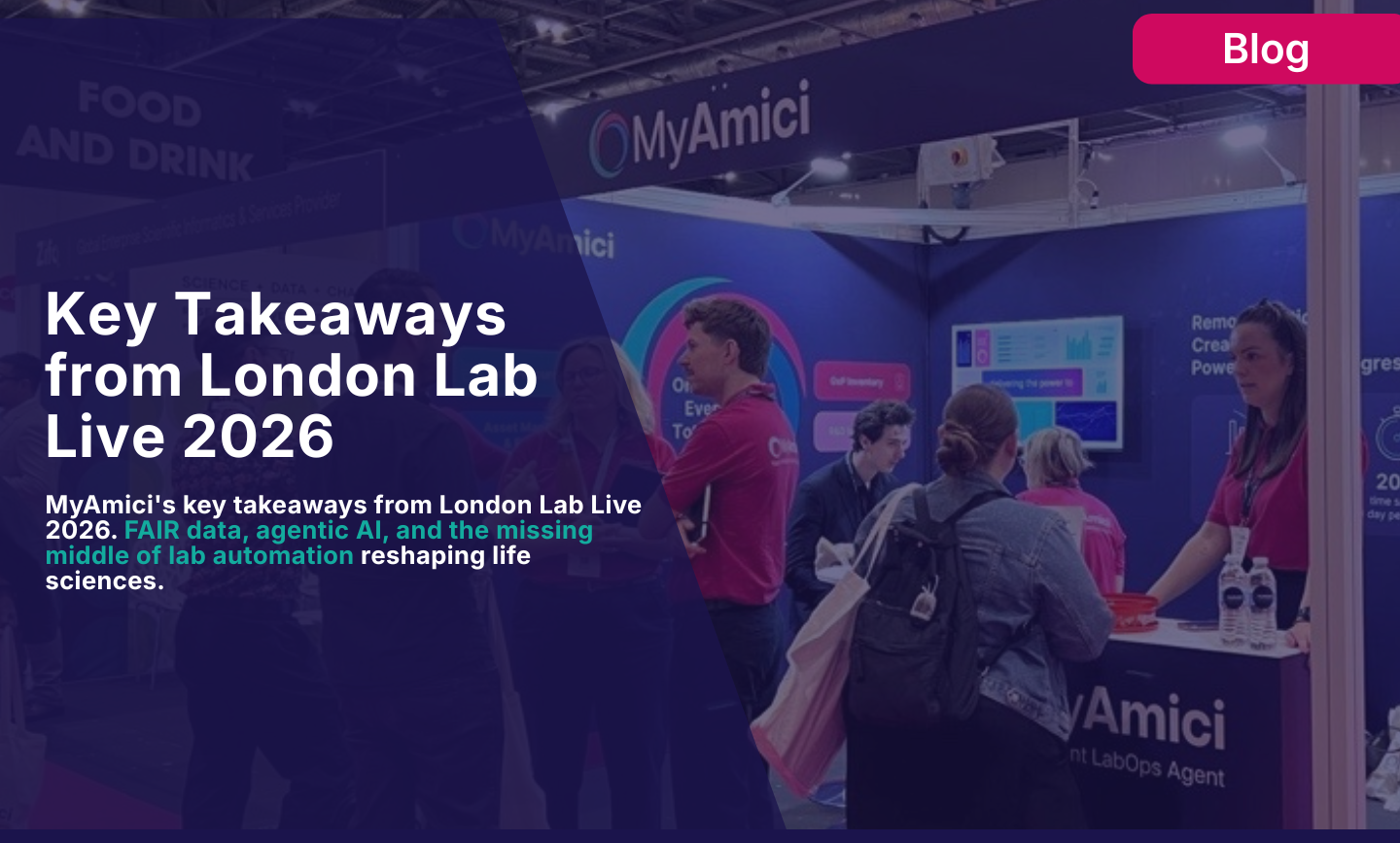
Two days at ExCeL London for London Lab Live 2026, where MyAmici was proud to sponsor and put a (very pink) team on stand C50. The floor was busier and more pragmatic than we expected with almost 5,000 attendees, more than 100 exhibitors, and conversations that kept circling back to the same handful of questions about where the lab is genuinely heading.
Here’s the themes that kept resurfacing for us across the two days, and what we’re carrying back into the work.
1. UK biotech is finding its feet again
The Day 1 keynote panel set a tone we didn’t entirely expect: buoyant. The message was that UK biotech and London and Cambridge in particular is showing real signs of recovery. Funding was still flagged as the biggest constraint, but with an important caveat: capital is available “where the science is good.” Investors haven’t stopped deploying. They’ve reset what they’re willing to back.
That’s a useful frame for the rest of the program. The labs and biotechs investing in operational infrastructure right now aren’t doing it because cash is easy. They’re doing it because credibility on operations is increasingly part of what makes the science fundable in the first place.
2. FAIR data was the throughline
If you’d asked us beforehand what the most-discussed phrase of the event would be, we probably wouldn’t have guessed FAIR data. And yet it surfaced in nearly every track, Findable, Accessible, Interoperable, Reusable as the foundation everyone wants for AI-ready labs.
A couple of sessions stood out. One large-pharma walk-through of an in-house FAIR implementation strategy was, for us, the most informative session of the conference with a lot of overlap with the data engineering work happening on our own side, particularly around building semantic ontologies (relevant to anyone re-mapping product categories) and the idea of ontology agents that can lean on specific patterns, FAIR data, and schemas to construct ontologies. An academic-led panel later in the program picked up the same thread from the research side.
A broader point ran through both. The labs that will benefit most from AI aren’t necessarily the ones with the biggest model budgets, they’re the ones with the cleanest, best-described data. Several presenters also pointed to Analytical Information Markup Language (AnIML) as an interoperability standard worth paying attention to alongside FAIR, especially for autonomous-lab use cases where machine-to-machine data exchange has to be lossless.
Underneath the headline use cases of AI, this is the quiet, unglamorous work that determines what’s actually possible.
3. The middle of the lab is the next frontier
Lab automation has come a long way. The connectivity showcase was full of impressive demonstrations of IoT-enabled equipment and end-to-end workflows, and one research-led session presented an ambitious end-to-end concept. AI and digital twins simulating and automating the full experimental cycle. (Not a working system yet, but an interesting architecture combining agentic and traditional message components.)
One observation stayed with us across the two days, though. The conversation was strong on two ends of the pipeline: AI and robotics for designing experiments, and AI and robotics for running them. What was largely absent was the middle, the bit between designing an experiment and the lab actually having the reagents, consumables, and equipment on hand to run it. The supply chain that feeds the automated lab.
There was a single, fleeting mention of inventory checking when one of the autonomous-lab discussions moved from planning to execution, and a passing comment elsewhere on how ingredient availability might (eventually) drive decision-making. But it wasn’t a thread anyone was pulling hard.
This is the space MyAmici works in, so we’re not unbiased but it does feel like the missing chapter of the autonomous-lab story. A 24/7 robotic lab still needs someone (or something) to keep it stocked, audit-ready, and connected to its suppliers. And as one of the automation presenters made clear, once a lab can run around the clock, the systems and processes that sit around it can’t go to sleep at 6pm either.
Find Out How We Can Help
Get in touch4. Agentic AI in labs: Real progress, and a lot of polish
“Agentic” was probably the second-most-used word of the event, after FAIR. The quality of what sat behind it varied wildly.
On the genuinely interesting end, there was thoughtful research-led work on agentic workflows that lean on off-the-shelf LLMs to provide context and a chat-style UX over upstream research data. We particularly liked the emphasis on identifying where data is missing and treating those gaps as blind spots to be closed, rather than quietly engineered around. One session gave a real-world academic case study of LLM-assisted reactor design, and pointed us toward ai4green.app, an open-source ELN aimed at organic chemists. It’s a sign of what we suspect is coming: more AI-coded, internal and open-source LIMS and ELN tools popping up over the next 18 months.
The label “agentic” itself stretched a long way across the floor, from genuinely novel architectures to lighter integrations on top of existing products. Worth looking past the badge at what’s actually under the hood when the demos start.
One useful thread ran through the connectivity showcase too: the right tooling can open up integration for older or second-hand equipment which matters for the long tail of kit sitting in real labs that won’t be replaced any time soon. Connectivity strategies that only work for the newest instruments aren’t strategies for most labs.
5. The human stays in the loop, by design
The Day 2 keynote panel was clear-eyed about what AI can and cannot do safely. Alongside the rush, there needs to be more education around data integrity and guardrails, small issues with data can mean the foundational experiments built on it are quietly wrong, and repeatability of results is non-negotiable.
The conclusion: there will always be a human in the loop, providing direction and authorisation. And critically, the controls should sit in the framework, the LIMS, the procurement system, the process tool rather than inside the AI itself.
That’s a quietly important architectural point. It means an AI-initiated purchase request should still flow through the same approvals, the same audit trail, and the same controls as a human-initiated one. The framework holds the line. The AI accelerates the work happening inside it. That’s a model we recognise.
One other point worth flagging from the Day 2 keynote: Europe has lost the LLM race, and is broadly behind both the US and China on AI generally but is genuinely ahead on lab automation and robotics. The (half-tongue-in-cheek) prediction was that we could see the first “Turing Nobel Prize” by the 2040s: a Nobel-quality piece of science completed end-to-end by a robot scientist. Worth watching.
6. Catching the Invisible Drag in Labs
A small note before we close. Our CEO and Founder, Caroline Briggs, took to Theatre 2 on the morning of Day 2 to talk about something the rest of the program kept brushing past: Invisible Drag – the low-value, friction-laden work that quietly costs labs roughly two days of science every week. Supplier chasing. Lapsed maintenance contracts. PhDs reduced to ordering pipette tips. (Harvard Business Review puts the number at 41% of skilled workers’ time lost to low-value tasks; in conversations on the stand, nobody we spoke to thought that was an overestimate.)
It was a useful counterweight to the bigger-picture AI conversation, and a reminder that the labs winning today aren’t necessarily the ones with the biggest AI budgets. The backbone comes before the breakthrough.
If you missed it, you can watch the recording here: Invisible Drag: Why Labs Lose a Day of Science Every Week | MyAmici
What we’re taking back
The shorthand version of two days at ExCeL: AI and automation are advancing rapidly at both ends of the lab, designing the experiment and running the experiment and the operational middle is increasingly what will decide how much of that potential gets realised. FAIR data, sensible governance, and a clear-eyed view of where the day-to-day friction actually sits matter more than the demo reel.
A real pleasure to be at London Lab Live as a sponsor, and a thank you to everyone who stopped by stand C50 for a chat. Reach out if you’d like to learn more?
Take the next step
If your team is wrestling with disconnected ordering, manual stock checks, slow approvals, or audit prep that takes weeks instead of hours, a LabOps platform can give you back control and give your scientists back their time.
Looking to simplify lab operations, procurement, and inventory management? See how our LabOps platform can support your organization across R&D and GMP environments.
Speak to the MyAmici team