
The Missing Piece in Your ERP: Procurement Built for Labs
Purpose built lab procurement that plugs into your ERP, giving scientists their time back and finance full visibility from day one.
Lab procurement software isn’t something most teams go looking for until the tools they already have start falling short. If you run an R&D, biotech or life sciences lab or a CRO or testing facility you’ve probably been told your ERP can handle procurement, or that a generic procurement platform, the kind your colleagues in finance use, would do the job just fine.
It won’t. And the gap between what those tools offer and what a lab actually needs is wider than most people realise until they’re living with the consequences.
This isn’t an argument against ERPs. SAP, NetSuite, Microsoft Dynamics and many others are powerful systems doing exactly what they were built to do. The problem is that none of them were built for science and in a lab, that matters in ways that only become obvious when challenges across various departments arise.
The fundamental problem: generic platforms are built for generic businesses
A standard procurement platform is designed for a business that buys repeat items for manufacturing, services, and indirect goods across many departments. It assumes the person placing the order knows what they need, the products are straightforward to find, and the main concern is budget control and approval routing.
A life sciences lab is categorically different. Scientists are buying across thousands of specialist scientific suppliers, ordering reagents with specific lot requirements, navigating SDS documentation and hazard classifications, working within GMP compliance frameworks, and often doing all of this without dedicated procurement support. The purchasing workflow in a lab isn’t just a finance process it’s a scientific one.
Generic ERPs and procurement platforms don’t carry scientific supplier catalogues. They don’t surface live stock availability and lead times at the point of ordering. They have no built-in HSE controls to flag hazardous materials before they reach the lab. They can’t validate inventory in a GMP environment without months of expensive customisation. And critically, they don’t come with a team who understands the science behind the purchasing.
The result is predictable: labs end up working around the system. Spreadsheets persist. Scientists waste hours on admin. Procurement happens by email. Compliance sits in a filing cabinet rather than a workflow. And finance sees spending data only after the fact, if at all.
Built by scientists, for scientists
MyAmici was founded by experts who experienced first-hand how inefficient procurement and lab operations slow innovation. That origin matters, because it shapes everything about how the platform works and who supports it.
Where a generic ERP requires a “super user” or a third-party consultant to configure and maintain it, MyAmici is designed to be intuitive for scientists and straightforward for admins to manage without complex training or specialist IT resource. Where a generic platform requires manual data input to generate a purchase order, MyAmici’s catalogue of over 20 million products comes pre-loaded with pre-negotiated pricing, live supplier lead times, and hazard information, so scientists can search, select, and order in the same workflow.
One customer described their experience before MyAmici like this: they were running an ERP system but using a separate Excel spreadsheet to track everything they needed to buy, then manually inputting that data into the ERP to route purchase orders through approval, and then manually contacting the supplier to place the order. That’s a three-step manual process where the technology was supposed to remove the manual work entirely.
With MyAmici, the order flows from the platform directly to the supplier via automated supplier integration no manual touchpoints, no separate spreadsheet, no contact required. ETAs, shipping notifications, and delivery updates come back automatically.
Find Out How We Can Help
Get in touchA pre-negotiated marketplace not an empty catalogue
One of the most significant differences between MyAmici and a generic procurement platform is what’s actually inside it.
Generic enterprise procurement platforms are often sold with catalogue capability, but the catalogue is only as good as what’s in it and keeping it current, with accurate pricing from hundreds of scientific suppliers, is a significant ongoing burden that falls on the customer. Prices aren’t negotiated by the platform. They reflect whatever terms you’ve already established directly with each supplier. If you haven’t negotiated a discount, you won’t get one.
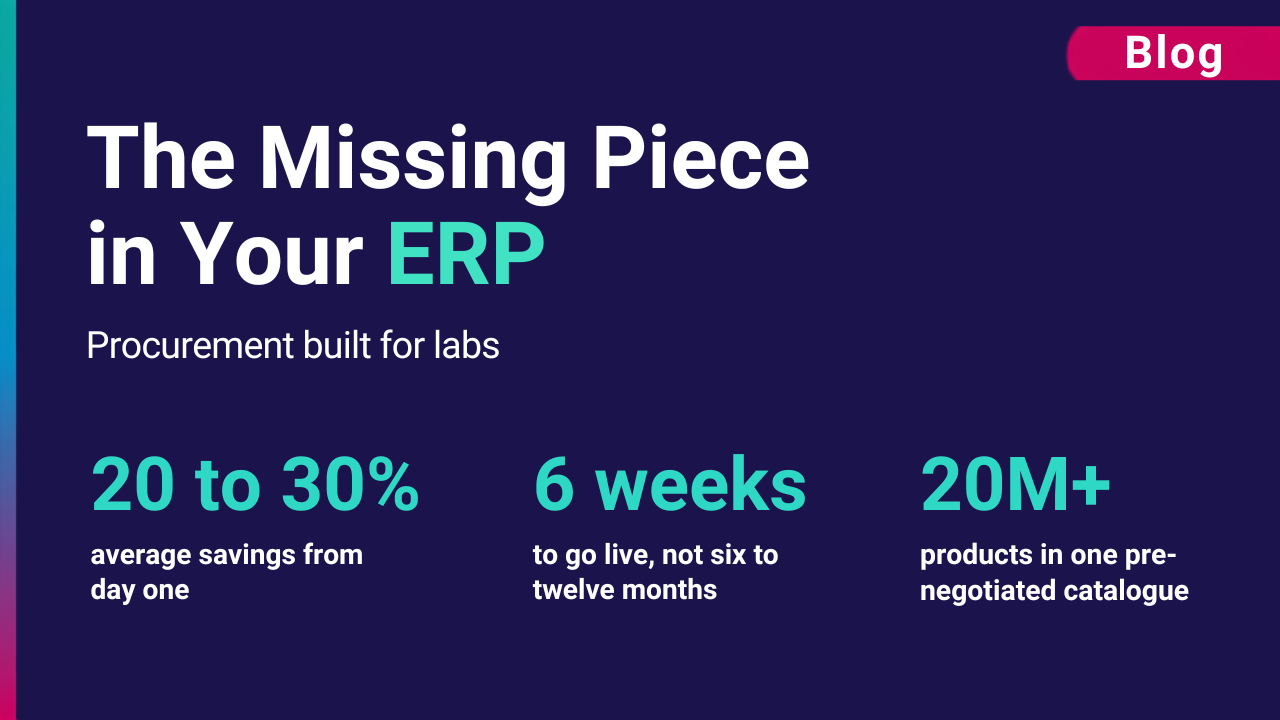
MyAmici operates differently. The 20 million+ product catalogue is pre-negotiated across our supplier network on behalf of all customers, with pricing benchmarked continuously and re-tendered on an ongoing basis. Customers benefit from group purchasing power, the combined volume of hundreds of R&D, biotech and life sciences organisations without needing to negotiate each contract individually. Delivery charges are frequently waived. Savings of 20–30% from day one are typical as MyAmici is one of the largest purchasers of lab consumables in Europe, providing buying power to our R&D, biotech and life sciences customers.
Sapphiros UK, an R&D and manufacturing organisation, quantified this after a full year on the platform: £204,000 in average annual savings on purchasing, with a further 55 days of time saved through MyAmici’s technical sourcing function.
Particularly for an R&D company, you very rarely get to celebrate saving money. So to be able to present average savings of £17,000 a month is just incredible.
Sam Hicks, Operations Manager, Sapphiros UK
The team behind the platform
Software alone doesn’t solve a procurement problem. The operational gaps in a lab, chasing suppliers, sourcing unusual materials, negotiating contracts, managing delivery exceptions all require people with scientific knowledge and procurement expertise working on your behalf.
That’s what MyAmici’s 65-strong team of scientific procurement specialists provides. They’re not generic procurement professionals, they’re people who understand the science, the suppliers, and the pressures of running a lab, combining lab operations expertise with deep supplier knowledge across the R&D, biotech and life sciences market.
For labs that don’t have their own dedicated procurement function, this team acts as a full procurement operation without the headcount. For labs that do have procurement or operations teams, MyAmici works alongside them absorbing the repetitive, transactional purchasing volume so internal teams can focus on strategic work rather than routine admin. It’s virtual headcount that extends the capacity and capability of whoever you already have in place.
Practically, this means: when you place an order on MyAmici, someone is watching it all the way through to delivery. If a supplier puts something on back order, you’re informed. If a lead time slips, it’s chased. If something isn’t arriving on time and you need it for a scheduled run, the team gets ahead of it. That proactive order management is simply not something an ERP or generic procurement platform provides because those tools don’t come with people.
Then there’s technical sourcing. When something isn’t in the catalogue, an unusual reagent, a piece of specialist equipment, a custom component, the sourcing team goes out to find it, negotiates pricing, checks availability, and brings it back with a recommendation. Sam Hicks at Sapphiros noted 55 days of time saved from sourcing alone in a single year. That represents a huge amount of administrative work that would otherwise fall on scientists or in-house procurement teams.
Compliance built into the workflow, not bolted on afterwards
Generic procurement and ERP platforms weren’t designed for labs operating under health and safety legislation or in regulated manufacturing environments. Compliance in those systems tends to be a layer added on top not something embedded into the purchasing process itself.
MyAmici treats compliance differently. HSE controls are embedded directly into the purchasing workflow, so hazardous materials are flagged at the point of ordering and require appropriate review before the purchase proceeds. Instead of a scientist placing an order and only later discovering the organisation lacks the infrastructure, approvals, or controls to safely handle the material, suitability is assessed upfront before the purchase is made. This is procurement functioning as a genuine control point in the hierarchy of controls not an administrative afterthought.
For organisations in regulated GMP manufacturing, the contrast with generic ERP systems is even sharper. MyAmici’s GMP Inventory module is the only configurable SaaS GMP inventory and purchasing system to have been audited by both the FDA and MHRA as part of customer implementations. It supports full lot and batch traceability, electronic signatures, automated quarantine workflows, FEFO management, and inbound inspection all out of the box.
Configuring a generic ERP to meet the same standard is not straightforward. The teams behind those platforms often don’t specialise in GMP or life sciences.
MyAmici’s team has guided customers through validation, supports the process with IQ and OQ validation packs as standard, and has a track record of implementations that have subsequently been inspected and cleared by regulators. Ascend Advanced Therapies, a CDMO in gene therapy manufacturing, implemented MyAmici’s GMP inventory solution as part of their transition to full GMP operations achieving an audit-ready system with complete batch traceability in a fraction of the time and cost a comparable ERP implementation would have required.
The transition went smoothly, with inventory being scanned and tracked accurately throughout the move. The efficiency and organization offered by the system made a significant positive impact during this critical period.
Cheryl Cruse, Ascend
One platform, not five systems
Walk into most mid-market R&D and life sciences labs and you’ll find procurement, inventory, and equipment management running across separate spreadsheets and disconnected tools. Each team has their own process. Data doesn’t flow between them. Nobody has a single view of what’s been ordered, what’s in stock, and what equipment is due for service.
MyAmici addresses this through a single integrated platform spanning lab purchasing, R&D inventory, GMP inventory, and equipment and asset management all connected to the same purchasing workflow. When stock runs low, a reorder can be raised directly from the inventory screen with supplier pricing already visible. When equipment is due for a service contract renewal, it’s visible in the same system as the purchase order that bought it. And when purchasing data needs to flow to your ERP or finance system, it does, automatically, in the format the ERP expects.
That’s the relationship worth being clear on: MyAmici isn’t asking you to rip out your ERP. It’s built to plug into it handling the lab-specific workflow your ERP was never designed for, while finance keeps working in the system they already know.
This extends to your supplier network too and it’s a gap one customer pointed out directly: building and maintaining individual supplier connections at that scale makes no commercial sense for a general-purpose platform serving many industries. It’s exactly the gap MyAmici is built to close.
Implementation in weeks, not months
ERP implementations are notorious for taking longer and costing more than planned. Significant IT resource, third-party consultants, months of configuration, and then an extended period before teams are actually productive. And at the end of it, you still don’t have the scientific catalogue, the supplier integrations, or the procurement team.
MyAmici can go live in as little as six weeks. Onboarding is guided, data is imported, supplier connections are live from day one, and training is handled as part of the process. The team who supports implementation is the same team who built the platform, they can make adjustments in real time, incorporate feedback from users during setup, and ensure the system reflects how the lab actually works.
In previous implementations, we had to rely on third-party consultants who could only tell us what was possible. With MyAmici, having support from the people who built the platform made all the difference.
Jamie Wilson, Senior Manager of Supply Chain, Ascend Advanced Therapies
There are no long gaps waiting for training to be scheduled. No months of the system sitting idle while consultants work through a configuration backlog. And no moment where you’re told what the system can do rather than having someone actually do it.
The bottom line
Generic ERPs and procurement platforms are strong systems for the purposes they were designed for. But they weren’t designed for R&D, biotech or life sciences labs. The combination of a purpose-built scientific marketplace, pre-negotiated pricing, embedded compliance controls, direct supplier integration, validated GMP inventory, and a 65-strong team of scientific procurement specialists is not something any generic platform can replicate because it was built for an entirely different audience.
For R&D, biotech and life sciences organisations trying to scale without adding overhead, manage compliance without complexity, and give scientists time back to do science, the question isn’t whether a purpose-built platform is better. It’s why so many labs are still trying to make a generic one work.
FAQs
Can a generic ERP handle lab procurement?
An ERP can process purchase orders, track spend, and manage approvals but it can’t replace a scientific procurement platform for lab use. ERPs don’t carry pre-negotiated scientific supplier catalogues, don’t surface live lead times and stock availability, don’t include built-in HSE controls for hazardous materials, and can’t be validated for GMP inventory without significant and costly customisation. Most labs using an ERP alone end up maintaining parallel spreadsheets or manual processes to bridge the gap.
What makes MyAmici different from a generic procurement platform?
Enterprise procurement platforms are designed for corporate indirect spend they’re not built for scientific purchasing. Their catalogues require the customer to manage supplier data and pricing, which is a significant ongoing burden for a lab buying from hundreds of scientific suppliers. MyAmici’s catalogue of 20 million+ products is pre-negotiated and continuously benchmarked. MyAmici also includes direct supplier integrations that send POs and return delivery updates automatically, embedded HSE controls, validated GMP inventory, and a specialist procurement team, none of which are offered by a generic enterprise procurement platform. MyAmici can also integrate with Coupa or an ERP as the financial system of record, so the two work together rather than in competition.
How long does it take to implement MyAmici compared to an ERP?
MyAmici can be live in as little as six weeks. A typical ERP implementation for a mid-market organisation takes between six and twelve months, requires significant internal IT resource, and usually depends on third-party consultants who add cost and slow the process. MyAmici’s implementation is handled by the team who built the platform meaning direct feedback during setup, real-time adjustments, and a go-live that reflects how the lab actually works from day one.
Does MyAmici replace our existing ERP?
No. MyAmici integrates with your ERP and works alongside it. MyAmici handles the lab procurement workflow, sourcing, ordering, approvals, supplier management, delivery tracking, and goods receipt and passes clean, structured data to your ERP in the format it expects. Finance continues to work in the ERP as normal. There’s no duplication and no parallel process to manage.
What does having a team of scientific procurement specialists actually mean in practice?
It means that when you place an order on MyAmici, a team is actively managing it through to delivery chasing suppliers when things slip, flagging delays, and keeping you informed without you having to ask. It means that when you need something unusual sourced, a specialist goes out to find it, negotiate pricing, and check availability. And it means that the expertise behind the platform in lab operations, supplier relationships, compliance, and scientific purchasing is available to you as an extension of your team, without adding headcount.
MyAmici is an R&D, biotech and life sciences procurement-as-a-service platform managing over £250 million in lab spend annually, trusted by more than 250 life sciences organisations including Sapphiros, Ascend Advanced Therapies, ImmuONE, F-Star Therapeutics, EnaraBio, and Valink Therapeutics.